What Is Quiet Luxury
Quiet Luxury Interior Design: Creating Calm, Connected Homes in a Digital World
Quiet luxury is not about what you see, it's about what you feel.
At Conway + Wise Interior Design, we define quiet luxury as understated elegance shaped by intention. It prioritises craftsmanship, natural materials, and timeless design over overt statements or visual excess. Often described as stealth wealth, it is a form of luxury that reveals itself gradually through atmosphere, proportion, and the way a space supports daily life.
In an era defined by speed, stimulation, and constant digital noise, quiet luxury has emerged as a powerful counterpoint. It reflects a growing desire for homes that feel calm, restorative, and deeply personal spaces that offer a sense of retreat from the outside world. A personal sanctuary.
What Is Quiet Luxury Interior Design?
Quiet luxury interior design is grounded in restraint, clarity, and cohesion. It moves beyond trend-driven aesthetics to focus on longevity, craftsmanship, and sensory experience, an approach increasingly sought after in high-end residential projects across Sydney and coastal Australia.
Rather than relying on bold contrasts or decorative excess, quiet luxury interiors are composed through subtlety: tonal palettes instead of high contrast, natural materials instead of synthetic finishes, bespoke detailing instead of off-the-shelf solutions, and balanced proportions instead of visual noise.
This design approach is not minimalism in the strict sense. It is not about having less, it is about choosing with precision. Every element is carefully considered for how it contributes to the overall experience of the home.
The result is an interior that feels effortless yet highly resolved, a home that does not demand attention, but quietly rewards it over time.
Why Quiet Luxury Is Defining Modern Australian Homes
The rise of quiet luxury interior design in Australia reflects a broader cultural shift. Our homes are no longer just places to live, they are spaces to restore, reconnect, and recalibrate. During Covid how we felt in our home became paramount to our wellbeing.
With increasing digital saturation and a volatile world climate, clients are seeking environments that feel calm rather than stimulating, grounded rather than transient, and cohesive rather than fragmented.
In Sydney in particular, where coastal living meets urban density, there is a growing demand for interiors that balance refinement with ease, spaces that feel elevated, yet entirely liveable. Our work across Vaucluse, Woollahra, and Paddington reflects this demand firsthand.
At Conway + Wise Interior Design, this informs our design thinking at every stage. We are constantly asking: how can a home reduce cognitive load? How can it feel quieter, softer, more intuitive to live in?
Reducing Cognitive Load Through Interior Design
One of the defining principles of quiet luxury is the reduction of cognitive load, the mental effort required to process a space. Highly detailed, inconsistent, or visually cluttered interiors can create a subtle but persistent sense of overwhelm. In contrast, quiet luxury interiors are designed to feel effortless and legible.
We achieve this through cohesion over contrast, where a restrained tonal palette ensures visual continuity and spaces transition gently, allowing the eye to move without interruption. We simplify material selections, limiting finishes to create clarity rather than layering multiple competing ones. Detailing is integrated so that handles, junctions, and transitions are resolved with precision, and each space is intuitive in its function with clear circulation and purpose.
The outcome is a home that feels calm, composed, and inherently comfortable, one that supports wellbeing on a daily basis.
Materiality: The Foundation of Quiet Luxury
Materiality is central to the success of a quiet luxury interior. It is through materials that we create depth, warmth, and authenticity. We prioritise materials that are natural, such as timber, stone, linen, and wool, that are tactile and invite interaction, that layer tonal variation rather than contrast, and that are designed to age gracefully.
Polished plaster walls introduce softness and depth. Natural stone provides movement and individuality. Timber brings warmth and grounding. These materials work together to create interiors that feel rich yet restrained, refined yet deeply comfortable.
Lighting as a Tool for Atmosphere
Lighting is one of the most powerful and often underestimated elements in interior design. In quiet luxury homes, lighting is never harsh or overly dominant. Instead, it is carefully layered to create atmosphere and support the rhythm of daily life.
Key principles include minimising reliance on downlights, incorporating concealed and indirect lighting, using warm soft colour temperatures, and creating variation between functional and ambient zones. Lighting is used to enhance materiality, highlight architectural elements, and create a sense of intimacy. The result is a home that feels warm, inviting, and effortlessly calm from morning through to evening.
Integrating Technology Without Visual Noise
Technology is essential to modern living yet it is also one of the primary contributors to visual clutter. Quiet luxury interior decoration embraces a different approach: technology should be present, but not prominent. This means seamless integration into architecture and joinery, concealed or flush-mounted solutions, minimal visual interruption, and intuitive functionality.
The most luxurious technology is the kind you barely notice until the moment you need it. This philosophy aligns with a broader movement towards homes that feel intentional and composed, rather than reactive and overstimulated.
Case Study: Vaucluse Residence — Sculptural Integration
A defining example of this approach can be seen in our award-winning Vaucluse residence. The home was designed as an expansive open-plan environment, incorporating multiple living and dining zones while maintaining a strong sense of cohesion.
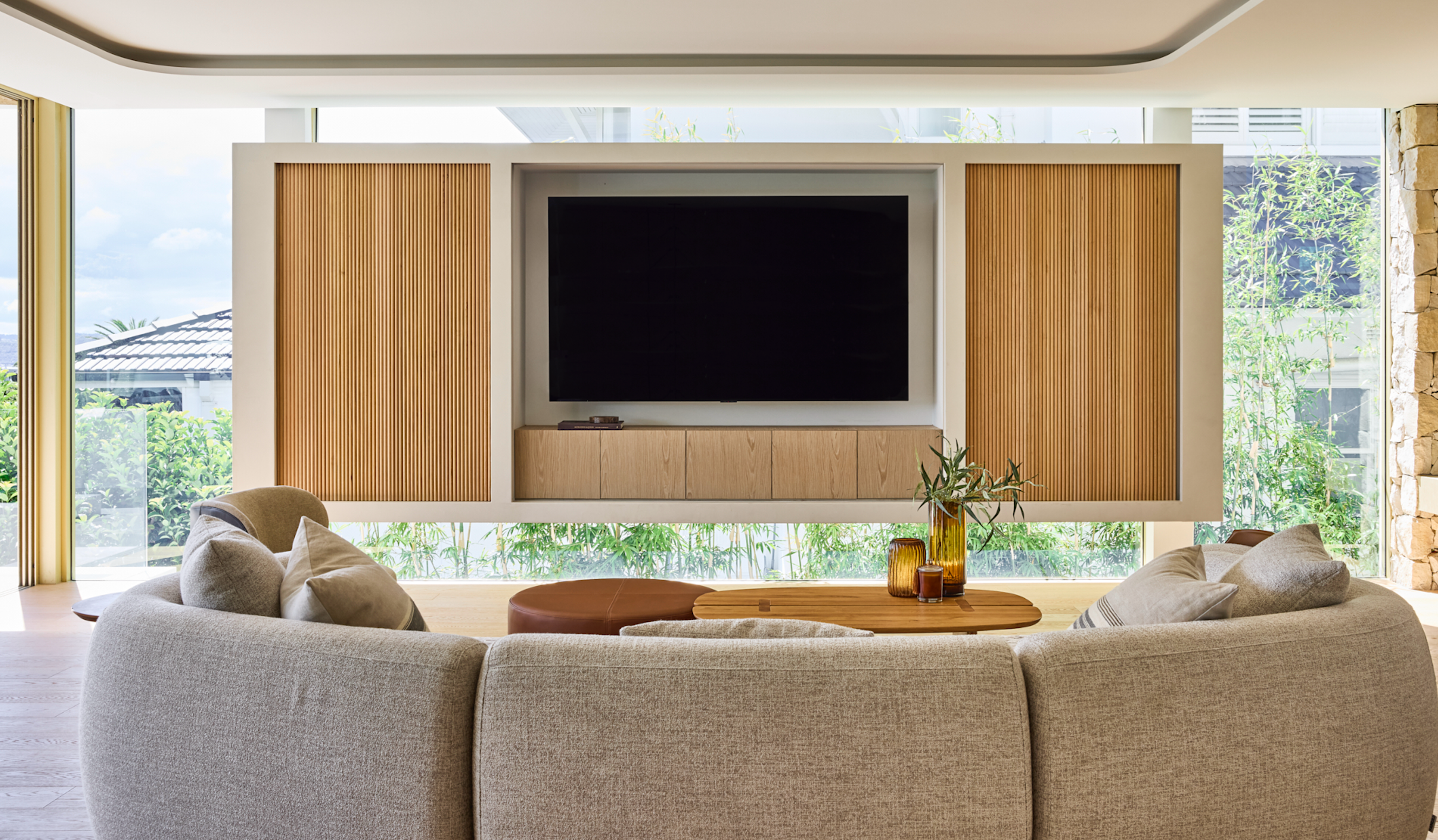
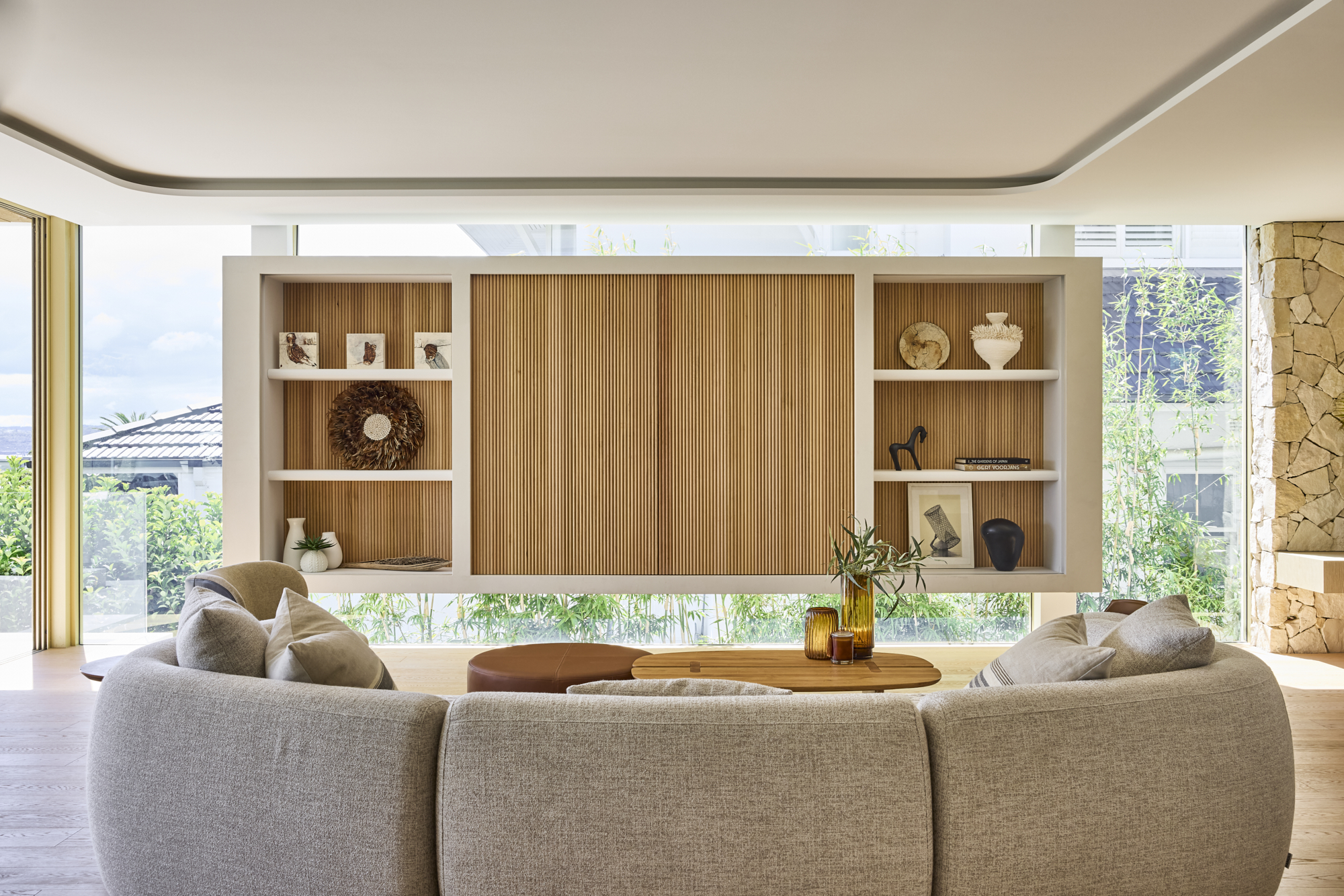
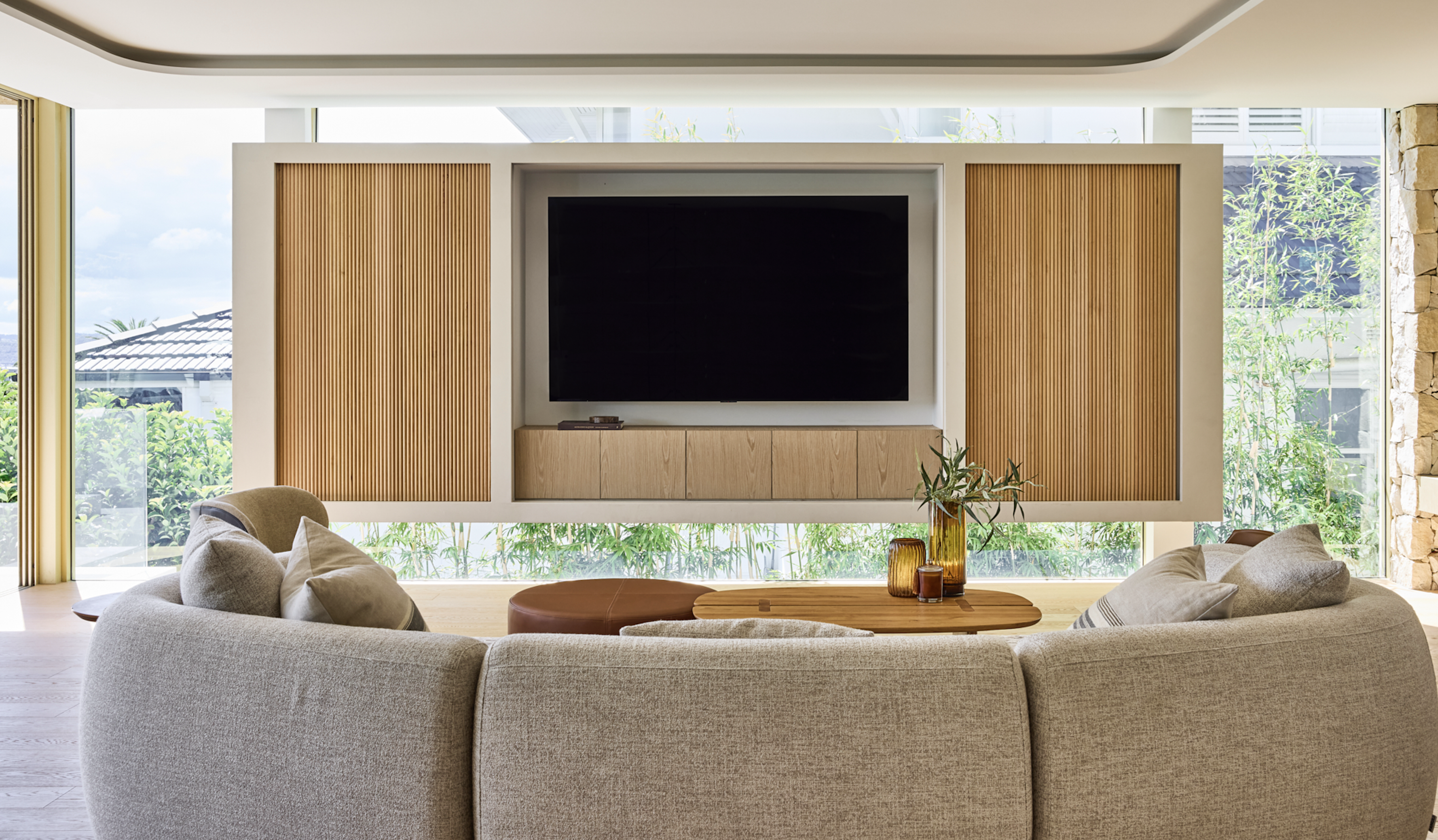
One of the key challenges was integrating a television into the main living space without disrupting the visual calm. Our response was a bespoke floating joinery element, crafted from polished plaster and timber and positioned within an expansive glass wall.
The piece appears to float within the space. The television is concealed when not in use, and when activated, it remains part of a sculptural composition. This approach transforms technology into a design feature rather than a focal point, allowing the space to maintain its clarity and elegance.
Designing Open-Plan Spaces with Intent
Open-plan living continues to define contemporary homes, but it requires a refined approach to maintain calm and cohesion. Rather than relying solely on walls, we define spaces through subtle level changes, material transitions, joinery elements, and lighting differentiation.
This allows for multiple functions within a single space, a balance between connection and privacy, and a consistent visual language throughout. In quiet luxury interiors, open-plan spaces feel fluid yet structured, expansive yet intimate.
Room-by-Room: Applying Quiet Luxury Principles
Living areas are designed for relaxation and connection. They prioritise comfort, proportion, and softness, with furniture carefully scaled and visual clutter minimised.
Kitchens are increasingly treated as architectural elements. Integrated appliances, concealed storage, and refined material palettes ensure they sit seamlessly within the home.
Bedrooms become true retreats, layered with soft textiles, muted tones, and gentle lighting to support rest and restoration.
Bathrooms embrace a spa-like quality, with natural stone, minimal detailing, and a focus on sensory experience. Each space contributes to an overall feeling of cohesion and calm. You can explore more examples across our selected projects.
Designing for Longevity and Sustainability
Quiet luxury inherently supports a more sustainable approach to design. By focusing on timeless aesthetics and high-quality materials, these interiors require fewer updates over time, reduce material waste, and encourage long-term thinking. Longevity is not just a visual outcome, it is a design philosophy. Homes designed this way remain relevant and functional for years to come, offering both environmental and emotional value.
The Emotional Impact of Quiet Luxury Interiors
The true success of a home lies in how it makes you feel. Quiet luxury interiors are designed to reduce stress, encourage calm, support connection, and enhance daily rituals. They offer a sense of stillness and clarity that is increasingly rare in modern life. This emotional dimension is what elevates quiet luxury beyond an aesthetic, it becomes a way of living.
Frequently Asked Questions: Quiet Luxury Interior Design
What defines quiet luxury interior design?
Quiet luxury interior design is defined by understated elegance, high-quality materials, and a focus on cohesion and longevity rather than visual excess.
Is quiet luxury the same as minimalism?
No. While both value restraint, quiet luxury is more layered and tactile. It focuses on richness through materiality rather than reduction alone.
How do you achieve a quiet luxury look in your home?
Focus on tonal palettes, natural materials, integrated detailing, and reducing visual clutter. Prioritise quality over quantity. If you'd like guidance, get in touch with our studio.
Is quiet luxury suitable for family homes?
Absolutely. In fact, it is ideal. By reducing visual noise and creating intuitive spaces, it supports a calmer and more functional daily life.
A More Intentional Way of Living
Quiet luxury represents a shift towards more intentional living. It encourages us to value quality over quantity, create spaces that support wellbeing, and design homes that feel calm and considered. At Conway + Wise Interior Design, this philosophy underpins every project. We believe the most luxurious homes are not the loudest but the ones that feel the most resolved.
If this approach resonates with you, we'd love to hear about your project. Reach out to our team or read more about how we work.
Conclusion: The Future of Interior Design
As our lives become more complex, our homes must work harder to provide clarity and calm. Quiet luxury interior design offers a refined, enduring approach, one that prioritises thoughtful materiality, seamless integration, and emotional resonance. It is not driven by trend, but by intention. And ultimately, it reminds us that true luxury is not about what we see but what we feel.